Orthodoxy came to America in four waves. The first wave was by missionary activity in Alaska, a land that belonged to Russia at the time. Russians began trading with natives for fur in the 18th century, and a very successful fur trading company was established on Kodiak Island—the Russian-American Company—along with a school for the indigenous people. Over time, under influence of the fur traders and with quite a bit of intermarrying, many natives converted to the Orthodox faith.
Wednesday, 13 November 2013
Магија и магизам: како се испољавају у нашем животу
Магија и магизам ни из далека нису иста ствар. Магија је окултна пракса, а магизам је поглед на свет саграђен на принципима магије. Дешава се да се човек никад у животу није бавио магијом, али да у свом погледу на свет, поступцима и погледима на живот испољава очигледан магизм. Данас је важно да разјаснимо ове појмове пошто неки саму религију често схватају као нешто магијско.
Пре свега ћемо покушати да објаснимо шта је магија.
Магија (лат. magia – чаробњаштво, враџбине) јесте скуп обреда и дејстава који имају за циљ да утичу на стварност у околини уз помоћ тајанствених сила. То су бајалице, заклињања, бацање и скидање чини и разноразни пратећи ритуали (на пример, везивање чворова, писање одређених речи и шема), као и потребни инструменти: талисмани, ножеви, игле, кости, длаке,крв, смоле, траве и т.сл.
Monday, 11 November 2013
The Theology of Christian Marriage
Marriage: an Orthodox view
The Orthodox Church understands marriage as a holy mystery (sacrament); the union of two human persons, one male and the other female, as a sign of the love of Christ for the Church, fulfilled in the Kingdom of God. There can be no such thing as a homosexual marriage.[1]
Friday, 1 November 2013
REFLECTIONS ON THE SEPARATION OF WESTERN AND EASTERN CHRISTENDOM
Archpriest Andrew Phillips
If we look at the lives or the works of Western Christians during the so-called "Dark Ages", the period from about 450 to 1050, we are invariably struck by their intellectual and cultural weakness their unformed, immature, even crude, theological outlook. Whereas in the third and fourth centuries we are able to find great Fathers (Blessed Jerome, Blessed Augustine), making their theological contribution to the development of Orthodoxy in the West, and also those who were working to spread the influence of Eastern Orthodoxy in the West (St. Hilary of Poitiers, St. Martin of Tours, St. John Cassian), in the sixth to eleventh centuries, there is a breakdown in the intellectual and cultural growth of the West. There are few indeed at this time who can stand comparison with the great mystical theologians of the East, where the great Ecumenical Councils were held and where the Faith was being formulated. Rome itself fades as an intellectual centre at this time. The light of knowledge was kept in distant places, by St. Isidore in Spain, Bede the Venerable in Britain, Irish Christians, some of whom knew Greek. Their knowledge, however, was vastly inferior to that of the Eastern Fathers, and a man like John Scotus Erigena, who translated some of the 'Pseudo-Dionysius' into Latin in the ninth century, stands out like a beacon in the darkness of ignorance. The holy men and women of the West in the 'Dark Ages' are as different from the great Egyptian, Syrian and Greek mystics of the multi-cultural Orient as Carolingian or Anglo-Saxon iconography is from post-iconoclast Byzantine iconography. Yet, although there were social, political and economic divergences between East and West, the Church was One. There were local, cultural variations in the practice of the Faith, but at heart Christians were united in their confession of the Orthodox, Catholic Faith. The East was a new and flourishing foundation, intellectually and culturally climbing to its zenith, the West was a fallen Empire, isolated by the Mohammedans from the cultural riches of Constantinople. The West was politically crippled by pagan onslaughts and invasions, living without a great cultural or intellectual awareness of the Faith and searching anywhere for political and military support against its enemies. It was even willing to crown a Frankish king and set up a Western Empire for the sake of self-protection. Spiritual unity, however, remained.
Thursday, 31 October 2013
The Truth About Halloween
By Catherine Beyer
What is Halloween?
Halloween is a secular holiday combining vestiges of traditional harvest festival celebrations with customs more specific to the occasion such as costume wearing, trick-or-treating, pranksterism, and decorations based on imagery of death and the supernatural. The observance takes place on October 31.
Though it was regarded up until the last few decades of the 20th century as primarily a children's holiday, in more recent years common Halloween activities such as mask wearing, costume parties, themed decorations, and even trick-or-treating have grown quite popular with adults as well, making Halloween an all-ages celebration.
Searching for Unlikely Spiritual Treats
In reality, there are probably few holidays and seasonal events that grasp our children's imaginations like Halloween, or "All Hallows Eve." Looking back on my own childhood, I have vivid recollections of the raw excitement of trick-or-treating on those chilly October nights. I remember the rows of houses lit up by glowing jack-o-lanterns, the piles of candy in my plastic jack-o-lantern, the thrill of being out with my friends at night, and the creepy movies I loved to watch in preparation for what was for my friends and me the biggest night of the year, next to Christmas Eve. It was a night of pure excitement, of independence—and I know my experience was not unique.
DO ORTHODOX CHRISTIANS OBSERVE HALLOWEEN?
The answer to this is in two parts: The Christian meaning of this day, and the anti-Christian meaning of this day:
The Christian “All-Hallows’ Eve”
“Halloween” is short for “All Hallows’ Eve,” that is, the evening before the Western Christian feast day of All Saints. “Hallow” is an old-fashioned word for “Holy”. So the “Day of All-Hallows” means the “Day of All-Saints.” “E’en” is short for evening. “Halloween” then, in its Christian meaning, refers to the evening before All Saints’ Day, which is November 1 on the western Roman calendar (the eastern Roman, or Byzantine, calendar places the commemoration of All Saints on the Sunday after Pentecost). This feast was instituted when old Rome and the Western European lands were still Orthodox, and therefore for centuries Orthodox Christians in the West observed All Saints’ Day on 1 November, and, like all traditional Christians, the pious people attended church services on the evening before the feast as well, which in this case was the eve of All Saints, or “All Hallows’ Eve” in old-fashioned English.
Wednesday, 30 October 2013
Tuesday, 29 October 2013
THE BEST OF LOU REED
Šest autora Jutarnjeg: 'Ove su nas pjesme uvijek pogađale izravno u trbuh'
Poput pisaca na koje je brijao kao student književnosti na sveučilištu Syracuse,Williama S. Burroughsa, Huberta Selbya Jr., Raymonda Chandlera i Allena Ginsberga, Lou Reed je u rock’n’roll pjesmaricu uveo mračne teme - narkomaniju, prostituciju, sadomazohizam, istospolni seks - učinivši od dilera, transvestita, prostitutki i džankija svima bliske junake pop imaginarija.Ozbiljno pisanje
Sunday, 27 October 2013
Lou Reed, Velvet Underground Leader and Rock Pioneer, Dead at 71lo
By JON DOLAN
Lou Reed, a massively influential songwriter and guitarist who helped shape nearly fifty years of rock music, died today on Long Island. The cause of his death has not yet been released, but Reed underwent a liver transplant in May.
With the Velvet Underground in the late Sixties, Reed fused street-level urgency with elements of European avant-garde music, marrying beauty and noise, while bringing a whole new lyrical honesty to rock & roll poetry. As a restlessly inventive solo artist, from the Seventies into the 2010s, he was chameleonic, thorny and unpredictable, challenging his fans at every turn. Glam, punk and alternative rock are all unthinkable without his revelatory example. "One chord is fine," he once said, alluding to his bare-bones guitar style. "Two chords are pushing it. Three chords and you're into jazz."
Preminuo Lu Rid
Pionir roka, Lu Rid (Lou Reed), umro je u 71. godini života, javio je Rolling Stone.
U martu 2006. Lu Rid je nastupio na koncertu u beogradskom Sava Centru. Pročitajte recenziju Žikice Simića "Sve jučerašnje zabave" ovde: Pesma „Who Am I? (Tripitena’s Song)“ kojom je Lu Rid završio oficijelni deo, fenomenalno posećenog i uspešno organizovanog, koncerta u Centru Sava bacila je neobično svetlo na ceo događaj: „Sometimes I wonder who am I/The world seeming to pass me by/A younger man now getting old/I have to wonder what the rest of life will hold“.
Legendarni tekstopisac i gitarista, se početkom godine podvrgnuo transplantaciji jetre a tačan uzrok smrti još uvek nije poznat.
Odlazak zadnjeg avangardnog transformatora pop kulture i rocka
Aleksandar Dragaš
Nakon transplantacije jetre, poduzete u svibnju, ponajveći i ponajvažniji rock-avangardist Lou Reed umro je u 72. godini života, a slučaj je htio da njegov posljednji za života objavljen album bude “Lulu”, prilično loše ocijenjena kolaboracija s Metallicom iz 2011. godine, kandidat za jedno od najbizarnijih, neki kažu i najodvratnijih, djela rock-glazbe.
Ta “neugodna” činjenica, a bilo je još svakojakih “bizarnosti” u Reedovu opusu, rođenoga 2. ožujka 1942. u njujorškom Brooklynu, nimalo ne umanjuje nevjerojatno značajan doprinos njujorškog avangardista rock-glazbi i pop- kulturi 20. i 21. stoljeća, bez kojeg bi teško bilo zamisliti na tisuće bendova, od The Stoogesa, Ramonesa i Televisiona preko Joy Divisiona, Talking Headsa, Public Image Ltd, R.E.M. i Nirvane do The Strokesa i Arcade Fire.
On Holy Baptism
Saint Tikhon Of Zadonsk
"He that believeth and is baptised shall be saved" (Mk. 16:16). Our Lord and Saviour gave us this saying for our confirmation and consolation. For what is more comforting to a faithful and baptized soul than this saying that promises it eternal salvation?
Beloved Christians, glory be to God that we both believe in the Gospel and are enlightened with holy Baptism. But let us look at the power of holy Baptism and we shall see what we were before Baptism and what we became after Baptism, that we may receive lively consolation from this.
Through holy Baptism we were delivered from every calamity and we received all true blessedness by the grace of God. Before Baptism we were far from God, but through Baptism we became close to God. Before Baptism we were enemies of God, but through Baptism we became reconciled to God, and God was reconciled to us. Before Baptism we were children of God's wrath, but through Baptism we were made vessels of God's mercy. Before Baptism we were children of darkness and children of the devil, but through Baptism we were made children of light and children of God. Before Baptism we were defiled in sins, but through Baptism we were washed, sanctified and justified.
Saturday, 26 October 2013
Collector of Beautiful Moments
Loudovikos ton Anogeion-Loudovikos of Anogeia is the stage name of the singer, composer and writer Giorgos Dramountanis .
His pronoun tells of his origin village, Anogeia, which is located on a majestic site at the foot of mount Idi, or Psiloritis (“High Mountain”), the highest mountain in Crete.
In this region there is a cave in which, according to folklore, Zeus was born. The hard topographical surface helped the local resistance in times of occupation: of the Turks in the 19th century and the Germans in the 1940s, which generated stories of the bravery of the locals. Several well-known songwriters and musicians originate in this region.
Sunday, 20 October 2013
Friday, 18 October 2013
Глобализам, национални идентитети и смисао подривања СПЦ (I)
Милован Бал
У данашњем времену глобалног „цунамија“, или империјалне експанзије, проблем очувања националних идентитета треба да буде најбитнији циљ вишеструко угрожених народа. Из идентитета народа произилази његов колективни субјективитет, али и индивидуална самосвест.Исто тако он (очуван идентитет) народу пружа, кроз историјско и савремено искуство, бистрину ума, којом се народ оријентише у лавиринтима савремених изазова, али и унутрашњу снагу помоћу које остварује зацртане стратешке циљеве. Није тешко закључити да онај народ који потпуно изгуби идентитетско упориште постаје дезоријентисан и представља лак плен глобалних разарајућих процеса, те погодан за усмеравање у правцу остваривања туђих, најчешће непријатељских интереса.
Sunday, 13 October 2013
The "God" of Western Theology
of Nafpaktos and Agiou Vlasiou
An internationally known Greek composer,1 when asked by a journalist "have you ever called upon God?", responded very bluntly: "No. I came from nothing and I am going to nothing. When I complete my cycle I will become dust. If this becomes an astral substance, it has no meaning, because I will not know about it. I would have already merged with universal harmony."
Do you Possess the Signs of Christ’s Beatitudes?
Our Christ and God calls to us every day through his Gospel: “blessed are the poor in spirit, because theirs is the kingdom of heaven”. When we hear this, we ought to be pay attention and examine ourselves carefully, to see whether we are really such poor people to the extent that we are aware in our souls that the kingdom of heaven will certainly be ours. Whether we possess its riches to such an extent that we feel without doubt that we exist within it and rejoice by plunging ourselves into the good things it has to offer. Because the Lord said that it is within us.
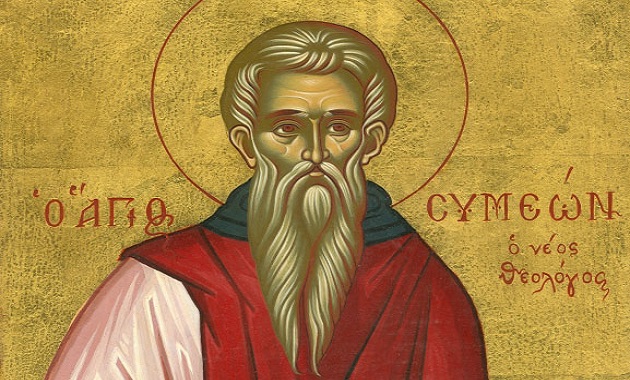
Saint Symeon the New Theologian as a Model for our Lives
St. Symeon the New Theologian (Feast Day - October 12)
By Protopresbyter Fr. George Papavarnavas
The venerable Symeon the New Theologian was born in 949 in Galatia of Paphlagonia (Asia Minor). He studied in Constantinople and subsequently entered the imperial court as a dignitary. Because, however, he sought higher things, he was not satisfied with worldly positions. He had the blessing to connect with Elder Symeon the Pious, under whose guidance he lived in spiritual asceticism. And while he was still a layman he obtained his first experience of the uncreated Light. At the age of 27 he entered as a novice in the Monastery of Studion and later in the Monastery of Saint Mamas, where he became a monk and was ordained a priest. After spending three years in the Monastery he was elected abbot, yet because he wanted to enforce the monastic rules of Basil the Great he was met with vociferous opposition from the monks and resigned.
KAKO NASLIKATI SVETLOST
Jedan od najznacajnijih danasnjih ikonopisaca protojerej Stamatis Skliris kaze da ikona, stvorena u otvorenom odnosu prema Bogu, uvek omogucuje ulazak u "drugi svet"
Posle trideset godina bavljenja ikonopisom i danas je ikona za njega velika tajna. Protojerej Stamatis Skliris, pored brojnih ikona, radio je freske u crkvi svetog proroka Ilije u rodnom Pireju, paraklisu sv. Jovana Zlatoustog u manastiru Celijama kod Valjeva, freske u kapeli manastira Decani, kao i ikone u manastirima rasko-prizrenske eparhije. U svestenicki cin rukopolozen je 1978. i sabirajuci sluzenje s talentom zivopisanja, danas predstavlja jednog od najvecih savremenih ikonopisaca.
Subscribe to:
Posts (Atom)